The City Of Sydney has approved the appointment of the National Breast Cancer Foundation, Settlement Services International Limited & the Sydney Children’s Hospital Foundation as the charity partners for Sydney New Year’s Eve, Sydney Lunar Festival & Sydney Christmas respectively.
Details about each charity are at the end of this article.
The approval was made following an Expression Of Interest (EOI) process in accordance with the City’s Support For Charities policy & is for the next edition of each event with the option to extend to the edition after that.
17 organisations applied to be an official charity partner of at least 1 event.
For Sydney Christmas, 2 extra criteria were added after the EOI closed, which was in early May 2023:
cash handling policy and,
point of sale infrastructure & floats for interactive activations
The applications were then assessed & then recommended to the Cultural & Creative Committee by:
Producer, Major Events and Festivals;
Audience Manager, Major Events and Festivals; &
Social Programs Officer (LGBTIQA+), Social City.
The Cultural & Creative Committee meeting, held on Monday the 19th of June 2023, then recommended the appointments to Council, who approved the recommendations on Monday the 26th of June 2023.
Now the Council has approved the appointments, the signing of Charity Participation Agreements are next & were due by mid-July 2023.
National Breast Cancer Foundation
National Breast Cancer Foundation is a leading not-for-profit organisation funding world-class breast cancer research. Since their inception in 1994, they have been involved in more than 600 world-class research projects across Australia & continue to fund further research to create a greater impact and help reach their vision of 0 deaths from breast cancer.
Settlement Services International Limited (SSI)
SSI is a not-for-profit organisation established over 20 years ago who provide life-changing human & social services. Their purpose is to empower individuals, children, families & communities from diverse backgrounds & identities to fully participate in the economic, social, civic & diverse cultural life of Australia. SSI’s mission is to create a more equitable, resilient, enriched & inclusive society.
Sydney Children’s Hospital Foundation
Sydney Children’s Hospital is one of the largest children’s health charities in the country. Since 1986, they have been delivering on their vision of a world where every child has access to the best healthcare when & where they need it. Each year, they raise vital funds for 5 of their key entities including Sydney Children’s Hospital Randwick, The Children’s Hospital at Westmead, Bear Cottage, Kids Research & Newborn and Paediatric Emergency Transport Service, to enable powerful change for children’s health care.
The City Of Sydney has been looking for new charity partners as part of an Expression Of Interest (EOI) process for the next edition of Sydney New Year’s Eve (NYE), Sydney Lunar Festival & Sydney Christmas with the option of the following edition after that too.
Charity partners use the respective events to promote and raise funds for their cause including through the event’s media & marketing campaigns. For Sydney Lunar Festival, they will also get speech & networking opportunities while for Sydney Christmas, they will get a merchandise stall.
The EOI revealed Sydney Christmas this year will have at their concerts interactive paid activations.
Aside from charities applying, throughout the EOI process, the City Of Sydney may also approach potential candidates.
The EOI process opened in late April & closed in early May. An evaluation panel will review applications with the successful charities:
being an official registered charity or public benevolent institution,
not being associated with religion,
undertaking work which produces significant community benefits,
aligned with the City of Sydney’s values,
values’ being important for the respective event &,
holding reasonably required insurances.
demonstrated previous experience in successful online fundraising (does not apply to Sydney Christmas)
providing & managing a minimum of 2 employees or volunteers to operate an interactive paid activation at each concert (Sydney Christmas only)
A recommendation will be sent to Council & once Council approves the recommendation, which should be by September 2023, the City Of Sydney will prepare letters of agreement.
The ABC unilaterally (that is, not in conjunction with the City Of Sydney) tried to repeat the success of the NYE2019 charity concert for NYE2020 by replacing the Red Cross with Lifeline & Kids Helpline as a result of the COVID-19 pandemic. However, it was not as great a success as NYE2019 despite the massive effects of the pandemic on mental health though it did raise about $700,000 on NYE alone (that’s about 5 cents per Australian).
Also interesting, the City Of Sydney specifically mentioned for the EOi that they reserve the right to not choose a charity partner, which is a very rare thing to do, and also to not hold the events, which is understandable, as we’ve seen during the COVID-19 pandemic.
Is the City Of Sydney about to bring back some creativity into Sydney New Year’s Eve (NYE)?
The City Of Sydney has announced they want to hear ‘fresh concepts’ & ‘innovative ideas with capacity to broaden the creative contribution’ of their events as part of a Big Creative Ideas process.
And they want to hear from anyone!
It’s not just Sydney NYE that want concepts & ideas for but any of their events including Sydney Christmas & Sydney Lunar Festival.
Proposals can be just 1 small thing to redesigning a whole event but they should be adaptable, sustainable proposals with “improved environmental performance”. Where applicable, they should be experienced by a live & broadcast audience. For a live audience, it should be accessible to a large-scale audience.
Proposals should also reflect the event’s traditions & objectives.
Lord Mayor Clover Moore said proposals should be similar in scale, timing and impact to their respective events.
We want to explore new technologies & ideas that may be included in our major events to showcase Sydney’s creative innovation to the world – this could include drones, light shows & projections – but the sky’s the limit.
Our aim is to build on Sydney’s status of producing cutting-edge, dynamic & extraordinary events that push the boundaries of innovation & leave a lasting impact on attendees and audiences.
City Of Sydney Lord Mayor Clover Moore
All Proposals Criteria
Creative concept including curatorial vision and detail, concept presentation, reference images & collaborating artists’ experience and calibre.
Relevant production experience including in carrying out services of a similar scale and nature.
Technical production ability
Feasibility
Risk
Sydney NYE Proposals Extra Criteria
Fireworks engagement reflection
Fireworks integration reflection
Sydney Harbour exclusion zone & its’ airspace focus (see map below)
8pm-12am activation (note: sunset is around 8:10pm & fireworks are held at 9pm-9:08pm and 12am-12:12am)
Clearly visible to a live audience about 650 metres away
Positioned to be filmed by Sydney Opera House television cameras
Global appeal
Meet major international event standards
Sydney New Year’s Eve 2022 – Pride Maritime Map Image: New South Wales Government
How To Apply
While applications close at 11am AEDT on Thursday the 26th of October 2023, there is an optional 1-hour briefing session to be held at Town Hall House, 456 Kent Street, Sydney on Thursday the 28th of September 2023 at 2:15pm AEST. This briefing session will also be held online. If you want to register for the optional 1-hour briefing session, e-mail crivilloosborne@cityofsydney.nsw.gov.au .
For more information on the Big Creative Ideas process, click here.
Successful applications will be notified in January 2024.
If you are successful, you may either make a shortlist to work with the City Of Sydney to develop the ideas or participate in a tender process or both.
As of 22nd August 2023, Sydney Spectaculars is no longer considering the Rugby World Cups 2027-29 as an ‘extraordinary’ Sydney Spectacular.
The reasoning behind this judgement is as follows:
A 3-minute fireworks display, using 2 barges & the upper arch and catwalk of the Sydney Harbour Bridge as well as a Bridge Effect featured after the Rugby World Cup 2003 – Australia Final.
A drone show is the modern equivalent of the Bridge Effect.
The FIFA Women’s World Cup – Australia & New Zealand 2023 had an event attendance of 79,000 per event day.
The FIFA Women’s World Cup – Australia & New Zealand 2023 was removed as an ‘extraordinary’ Sydney Spectacular on 5th April 2023. The reasons, at the time, are detailed here.
19 days into FIFA Women’s World Cup – Australia & New Zealand 2023, 13 Sydney landmarks, including the western sails of the Sydney Opera House, were lit up in gold. In all but one case, green was also added. These illuminations were done on the night of a Round Of 16, Quarter-Final, Semi-Final, 3rd Place Playoff or Final match involving the Matildas. However, this was insufficient for the FIFA Women’s World Cup – Australia & New Zealand 2023 to be readded as an ‘extraordinary’ Sydney Spectacular. The reasons are detailed here.
No Sydney Harbour (Bridge) fireworks display or drone show featured during the FIFA Women’s World Cup – Australia & New Zealand 2023.
In 2019, World Rugby decided that the words ‘Rugby World Cup’ would now refer to both the men’s and women’s editions.
The Rugby World Cup – Australia 2003 (men’s edition) had an event attendance of 66,000 per event day.
The Rugby World Cup – Japan 2019 (men’s edition) had an event attendance of 65,000 per event day.
The Rugby World Cup – New Zealand 2021 (women’s edition held in 2022) had an event attendance of 15,000 per event day.
Sydney is the likely host city of the Opening Match & Final of the Rugby World Cups – Australia 2027-29.
As the Rugby World Cup – Australia 2003, Japan 2019 & New Zealand 2021 all had attendances lower than the FIFA Women’s World Cup – Australia & New Zealand 2023, this means no more than 13 Sydney landmarks, particularly the western sails of the Sydney Opera House, should be lit up in gold during the Rugby World Cups – Australia 2027-29. In all but one case, green is added as well. This would happen only IF the Wallabies or the Wallaroos make it to the Quarter-Finals, Semi-Final, 3rd Place Playoff or Final of those respective future tournaments. Also, no Sydney Harbour (Bridge) fireworks display or drone show should now be expected during those tournaments.
As these illuminations were insufficient to be considered an ‘extraordinary’ Sydney Spectacular for the FIFA Women’s World Cup – Australia & New Zealand 2023, Sydney Spectaculars is of the opinion that the same should apply to the Rugby World Cups – Australia 2027-29, which is, as stated above, now very likely to be an event of less attendance & importance as the just-concluded FIFA Women’s World Cup – Australia & New Zealand 2023.
Therefore, as of 22nd August 2023, Sydney Spectaculars has decided to downgrade the Rugby World Cups – Australia 2027-29 from an ‘extraordinary’ Sydney Spectacular to just another Sydney Spectacular but not a ‘flagship’ Sydney Spectacular as it is not an annual event.
This is another major blow for Sydney’s event industry, culture & night-time economy. As, like with the FIFA Women’s World Cup – Australia & New Zealand 2023, there is a very likely lack of a major Sydney Harbour (Bridge) fireworks display & drone show (which would replace the Bridge Effect), it will be another notable absence in the history of major events in Sydney, reducing the significance or chance of hosting future mega events like the men’s FIFA World Cup.
If Sydney Spectaculars finds out that the either of the Rugby World Cups – Australia2027-29 will be treated like the Rugby World Cup – Australia 2003 (except with a drone show instead of a Bridge Effect), we will immediately resume coverage of the event but at this stage, it looks very unlikely. There is still every chance for a projection on the Sydney Opera House but. as stated above, this is insufficient. A stand-alone drone show is possible but such a drone show could have been held anywhere in the world – it just would be themed to Australia.
To bring Sydney’s mega event status back to where it belongs, Sydney Spectaculars will also lobby to World Rugby, the New South Wales (NSW) Government & Rugby Australia until those future tournaments are held to put on a Sydney Opera House/Harbour (Bridge) fireworks display & drone show during the Capping and Opening Ceremonies & after the Final as well as tournament-long projection/light shows on the Sydney Opera House/Harbour Bridge during those future tournaments after the failure to do so by the NSW Government, Football Australia & FIFA during the recently-concluded FIFA Women’s World Cup – Australia & New Zealand 2023.
We will review this decision after the Rugby World Cup – France 2023 (men’s edition), which begins today, as well as the Rugby World Cup – England 2025 (women’s edition).
We wish the Rugby World Cups – Australia 2027-29 every success.
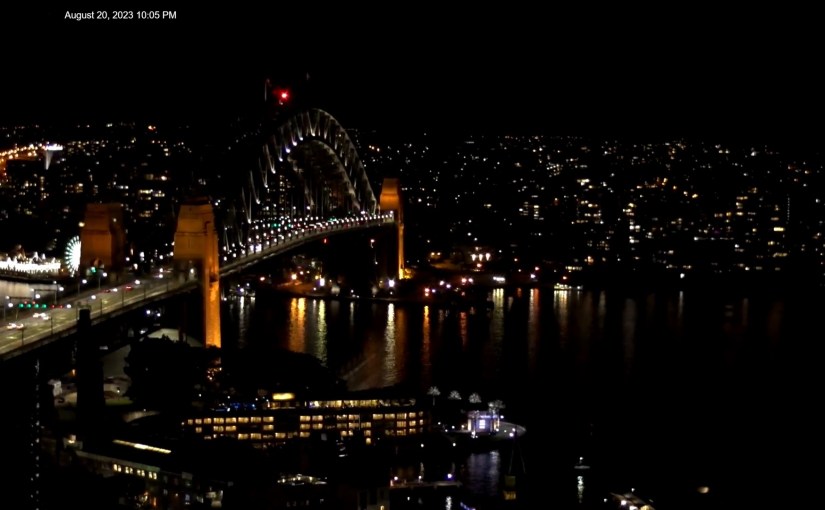
The image above, from EarthTV, shows the Sydney Harbour Bridge at the moment of full time of the Final of the FIFA Women’s World Cup – Australia & New Zealand 2023 when Spain won the tournament. Below is a YouTube video showing the Sydney Harbour Bridge after the Final of the Rugby World Cup 2003, which before the more-recent tournament was held, was the nearest similar-sized sporting event Sydney had hosted.
Sydney, what has happened? Where are the big celebrations for the FIFA Women’s World Cup 2023 Final?
No doubt the tournament was a success on its own. In terms of the football played, attendance, broadcast viewership and the promotion of female association football participation, it was a massive success. With 79,000 spectators per event day, it became the largest sporting event Sydney has hosted since the 2000 Paralympics – beating the 2003 Rugby World Cup‘s 66,000 per event day. Unsurprisingly, the Matildas captured Australia’s heart as they journeyed to their best ever Cup result – 4th. This result has largely hidden mostly from view the lack of activation in Sydney especially around the time of the final though early in the tournament, a 3rd of Sydneysiders seemed to be well aware of this.
We say ‘Unsurprisingly’ as any Australian sports fan (that is pretty much every Aussie) knew the Matildas had the potential to go far in this tournament particularly at home. Their best result before 2023 was to reach the quarterfinals. Reaching the semi-finals was historic. However, it seemed New South Wales (NSW)’s politicians were completely unaware of the massive juggernaut that was approaching, even if the Matildas ended up having a shock elimination in the group stage (which nearly happened). It took them until the Matildas made it to the Round Of 16 to start activating Sydney in any real sense, using that milestone to mark a ‘unique’ achievement despite the Matildas having achieved it in the past 4 tournaments!
The NSW Premier has to be given leeway. In early May, he declared an ‘only necessary’ Sydney Opera House projection policy to save costs. This was after it was revealed the Opera House didn’t light up for the Coronation of Charles III (There was no historical precedent to justify it). The policy was well needed as the World Heritage site was being lit up too much – too much for us to even keep track of! Essentially, it was to keep the Opera House projections to just Vivid & Australia Day but out of the possible extra reasons to light up the Opera House, our co-hosting of the FIFA Women’s World Cup was a must. It took them 19 days INTO the tournament to justify celebrating the event! Mostly, it was because the Premier clung too tightly to his relatively new policy.
Whilst any country would think it is right to celebrate a national team’s success, historically, for Sydney’s major events, this has been for historic milestones in tournaments hosted out of the country. When it is hosted by us, we celebrate every country & the event itself. This time we didn’t. It looked selfish, particularly when the Matildas headed to the 3rd place playoff rather than the Final. Nothing was done for the Final to celebrate England & particularly, Spain’s achievements. The question is would they have done anything if it was the Men’s tournament where the Socceroos are not among the top 10 teams in the world & rarely make it out of the group stage? Highly likely they would have particularly as the Men’s tournament is still double the size of the Women’s but that is beside the point as in 2003 for the now-smaller Rugby World Cup we did do something and as we pointed out in April, the Rugby World Cup refers to both men’s & women’s tournaments since 2019 so the FIFA Women’s World Cup, for Sydney’s events, had to be treated as much as like the men’s tournament as possible but why wasn’t it?
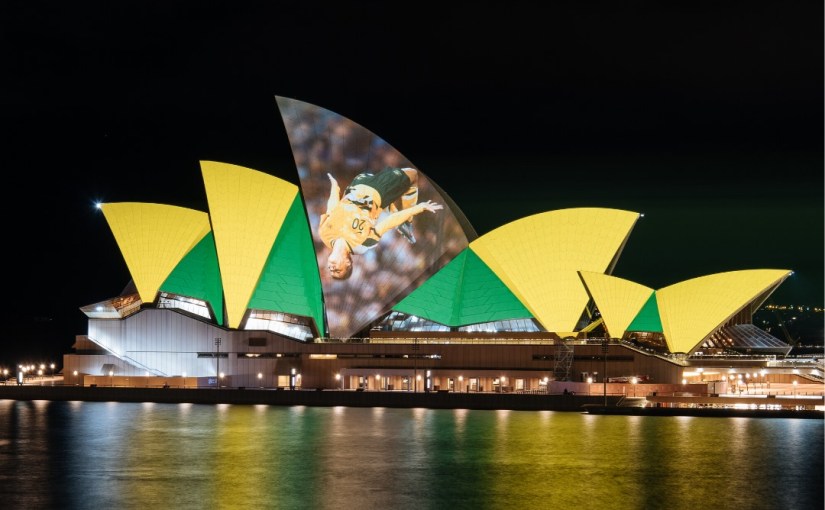
Matilda, Sam Kerr’s flip, projected on the Sydney Opera House to celebrate Australia winning the co-hosting rights for the FIFA Women’s World Cup 2023 Photograph: Sydney Opera House
The reason is simply – marketing and political imperatives have overtaken the community and creative aspects. This is notable particularly as the Sydney Opera House was lit up for when we won the bid to co-host the FIFA Women’s World Cup (above) & the Sydney Harbour Bridge eastern pylons to celebrate for 1 year to go (below) but nothing for the event itself as the ‘hard work’ had been done.
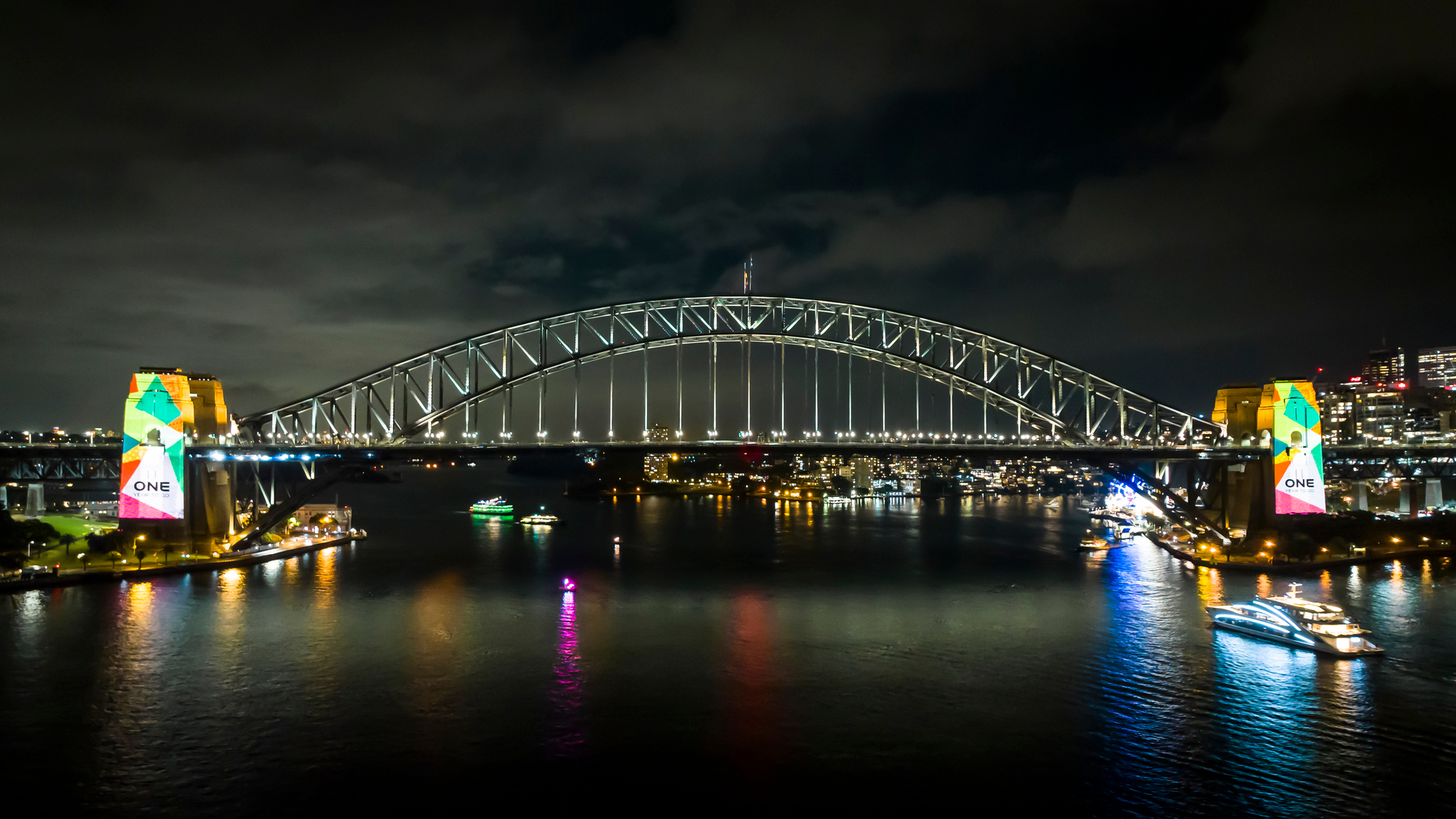
Sydney Harbour Bridge eastern pylons lit up to celebrate 1 year to go until the FIFA Women’s World Cup – Australia & New Zealand 2023. Photograph: Getty Images
On September 24 1993, everyone was awake at 5am to find out whether we would host the Olympics and when we did, the whole city turned into 1 party from 1997, when the first Olympic Art Festival began to 2008, when the Pope headed back to Vatican City after World Youth Day. We welcomed everyone – foreign, indigenous, with a disability – everyone, and we gave our athletes and volunteers thank you parades.
Sydney’s golden era in events was between 1997 & 2008 when it began with the iconic Games Of The XXVIIth Olympiad (1997-2000) and Millennium celebrations (1999/2000), followed by the II Summer Paralympics (2000), the Centenary Of Federation (2001), the Rugby World Cup (2003) and World Youth Day (2008). When the Opening Ceremony of The Games Of The XXVIIth Olympiad began, we did not the stop the party then and there because the ‘hard work’ of branding, marketing and testing the city was ‘done’. We partied for 7 more years! But now we don’t anymore.
In 2006, the New South Wales Coalition, then in Opposition, voiced concerns that our neighbouring Victoria was ‘out-doing’ Sydney in the tourism and events industry with bigger budgets, a dedicated major events corporation & the March hosting of the XXVIIIth Commonwealth Games. The high Sydney had experienced post-Olympics was also coming to an end sooner than expected even though World Youth Day was 2 years away. But what was sooner was a state election in March 2007. The Opposition promised a major events corporation for NSW if elected. 2 months from the election, Labor, then in Government, also promised one and immediately commissioned a review into NSW’s major events. This is when politics became intertwined with NSW’s events.
In the last 2 years of these golden era, the warning signs of the impending disaster were shown. In September 2007, a Bridge Effect (the iconic symbol that used to be placed on the Sydney Harbour Bridge for major events) was created for the Asia-Pacific Economic Cooperation (APEC) Summit Leaders Week, an event that had an event attendance of 4000 per event day. The event was controversial for its over-the-top security (famously thwarted by satirists, The Chaser) but also for the fact that the Leaders had their own private (and expensive at that!) Sydney Harbour fireworks display, which The Chaser also satirised:
At the time, this did not stand out as significant. Bridge Effects were done for every major event since the Millennium. 1 extra would not hurt. That would change 10 months later but this was the first sign that politicians were starting to use Sydney’s events to squeeze political capital out of them outside of election campaigns.
In July 2008, the biggest event since the Olympics finally hit town: World Youth Day 2008, a Catholic youth festival. Sydney sparkled during the week with the Pope travelling down Sydney Harbour in a “boatacade” and massive masses held throughout Sydney with a Stations Of The Cross re-enactment being the key headline act outside of religious services. An event of this size deserved a Bridge Effect, most likely a Cross in the middle of the Harbour Bridge, but nothing was done. Instead, a relatively new technology was used: projection mapping. Both eastern pylons of the Sydney Harbour Bridge were lit up with projections for the event.
World Youth Day 2008 Sydney Harbour Bridge Pylon Projections Photograph: Time
It was something new for a major event, but it was not its debut. It debuted 2 months earlier for the FIFA Congress (1500 per event day) but only on the south-eastern pylon. The innovative use of the pylons hid the real reason why a Bridge Effect was not done: It was cheaper. This led the APEC Summit Leaders Week Bridge Effect to be the last non-NYE Bridge Effect before its demise in 2015 when the company that built it went bust. The only other non-NYE event it could have been used for was the International Fleet Review Spectacular in 2013 but their extraordinary use of projections really made up for its loss and the show’s conclusion showed what the Bridge Effect would have been – the Royal Australian Navy logo. In the end, July 2008 was when Sydney’s events were starting to be used for solely marketing purposes by spending the minimum to ‘reach’ the most branding-wise but without putting extra effort into entertaining the attendees like by putting up a Bridge Effect or putting on a special Harbour fireworks display.
‘Events NSW’ projection during the FIFA Congress, 28-29 May 2008 Photograph: Events NSW
The FIFA Congress was the beginning of a push to win the hosting rights of the 2022 FIFA World Cup, which were controversially given to Qatar 2 years later. When the FIFA Congress was held in May 2008, it coincided with the creation of Events NSW, the major events corporation promised at the March 2007 state election to host & create events like Sydney knew how, which was formally brought into being in November 2007. It was headed by John O’Neill, who ran Australian Rugby Union and thus, was the main man regarding the 2003 Rugby World Cup. He also did the 2007 major events review on behalf of the Government.
The aim of Events NSW was to create a ‘Master Events Calendar’ to promote events in NSW while also promoting 5 anchor ‘events’. Released in October 2008 for 2009, it revealed the names & types of the 5 anchor events:
Vivacity Sydney
Autumn Racing Carnival
Vivid Sydney
Crave Sydney
Australian Open Golf Championships
The Australian Open Golf Championships had been held in Sydney since 2006 so this was not suddenly a deservedly ‘anchor’ event. Same with the Autumn Racing Carnival, a multiple-week thoroughbred horse racing carnival. Calling these events ‘anchor’ events, when the general public did not consider them as one was never going to work. If there was going to be an ‘anchor event’, it would have been Sydney New Year’s Eve (NYE) with an attendance of 1.5 million per event day but no, they did something different for that event.
The other 3 events were not existing events but new brands for Sydney’s events. The first one, Vivacity, was a brand for all of Sydney’s summer events including NYE. This was never going to work as it was just a label covering all existing events to make it look like the NSW Government put on the events when really it was mainly local governments & non-government organisations. The only event that was NSW Government-run was the NSW Art Gallery special exhibition during the period. The Vivacity brand lasted just 2 years though was pretty much forgotten after 1.
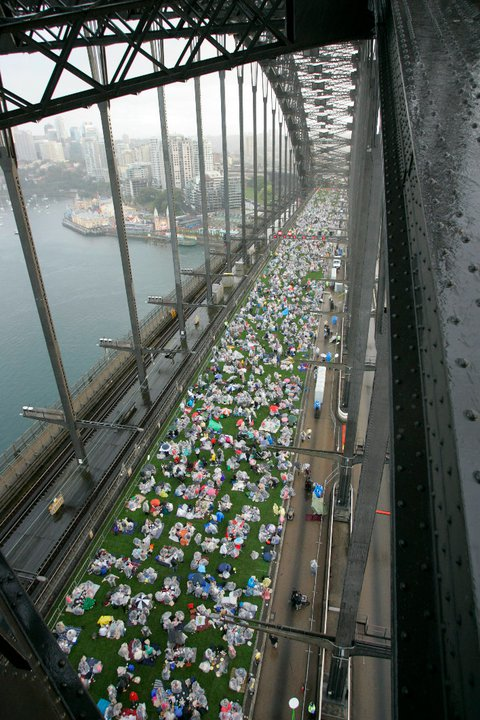
Crave was another over-brand for outdoor/food/art events in Sydney during October but they did create a new unique event: Breakfast On The Bridge, a picnic event on the Sydney Harbour Bridge where the roadway was turned into a grassy pasture. This event without a doubt was going to create buzz & did indeed get people’s attention but with the logistics of closing the Sydney Harbour Bridge in the morning for a breakfast for just 6000 people rather than say a fireworks display at Midnight for 1.5 million people, it was not a surprise it lasted just 2 years before moving to Bondi Beach for its final edition.
Breakfast On The Bridge 2010 Photograph: Breakfast On The Bridge
The final event needs no introduction – Vivid. Again, originally intended to be just a brand name, it was for creative events during late May & early June. This event whilst also containing existing events had numerous new events, which more importantly played to Sydney’s strengths. It included a new festival called Smart Light Sydney, a walk of eco-friendly light installations around Circular Quay, to be held biannually, to be headlined by the use of the new projection mapping technology on the sails of the Sydney Opera House. This event had the potential to become big particularly as it did not involve any logistical issues like Breakfast On The Bridge. No need to tell you how that event turned out…
John O’Neill was replaced in 2010 by John Conde, who had an interest in sporting events, primarily the controversial Sydney 500 (57,000 per event day) and the Asian Football Confederation Asian Cup 2015 (39,000 per event day), the latter a reaction to our failed 2022 FIFA World Cup bid & the former a reaction to the impending closure of Oran Park Raceway & the 28,000 per event day V8 Supercar Championship Series attendance of Eastern Creek International Raceway.
Whilst focusing on brands & marketing, Events NSW did succeed in doing its most important job – creating the next big event like Sydney NYE and that was Vivid Sydney (144,000 per event day) but that could be more of a happy accident than a well-thought-out events strategy given the other 2 brands failed. In late March 2011, a State Election was held and a change in Government occurred for the 1st time in 16 years. 3 months later, legislation was introduced to dissolve Events NSW and create Destination NSW, which combined Events NSW & Tourism NSW. With an emphasis on ‘Destination’, it was primarily a tourism marketing agency.
There has also been a distinct lack of cohesion between our success in acquiring events, our strategies to enhance them & our marketing and promotion activities in attracting visitors to New South Wales.
George Souris, Major Events Minister, Destination NSW Bill 2nd Reading,17 June 2011
No new events of note have been created during Destination NSW’s run so far & in fact, instead took tight precious control of the Vivid Sydney brand the former Events NSW agency created to use its social media friendliness to boost tourism marketing of Sydney, expanding the event to such lengths that crowd control is annually a serious concern. However, as you have seen on our blog since 2019, existing events like State Of Origin (1982), Australia Day In Sydney (1989) & Airshows Downunder Shellharbour (2006) have been encouraged to use Sydney’s strengths to prop up the lack of creativity in new or mega events.
In 2014, John Conde left as chairman of Destination NSW to be replaced by John Hartigan, a former media executive. The media & events industries are very intertwined through broadcasting, but an event & a broadcast of an event are 2 completely different things. An event can be attended by many people but with no broadcast while an event in a broadcast may be attended by very few people.
This is when the decline truly began & more importantly, became obvious, all hastened by the Bridge Effect’s demise. With the Bridge Effect gone, Sydney NYE also shifted to a focus on annual artworks with a minimalist theme before in 2019, completely ditching themes & the artworks to focus on ‘visual identities’, though there was a slight hint of a theme in each edition.
In 2018, John Warn, a retail executive, was appointed as Destination NSW chair. Again, a completely different industry, with marketing at its core.
We want to attract the world’s best and biggest events right here in NSW
Rugby World Cup 2027- 103,000 per event day (NSW last (co-)hosted it in 2003)
International Cycling Union Road World Championships 2022 – 78,000 per event day
FIFA Women’s World Cup 2023 – 68,000 per event day
International Cricket Council (ICC) World Twenty20 2020 (men’s & women’s) – 41,000 per event day
Rugby League World Cup 2029 – 26,000 per event day (NSW last (co-)hosted it in 2017)
Netball World Cup 2027 – 16,000 per event day (NSW last hosted it in 2015)
World Team Cup 2020-2030 – 11,000 per event day. Last held in 2012.
Women’s Rugby World Cup 2021 – 4,000 per event day
Rugby League World Cup 9s 2019 – Event didn’t exist yet
You can see, despite the claim of “world’s best & biggest”, outside of the top 3, these events were actually chosen with NSW voters in mind with their favourite sports of rugby league, cricket & netball, particularly with ‘tested-and-tried’ events that we pretty much just hosted like the Netball & Rugby League World Cups. 1 event didn’t exist yet so was made just for Sydney, yet still needed to use the Sydney Harbour Bridge pylons to market it – it only lasted 1 edition before folding. The bizarre World Team Cup inclusion, which was a relic of history, was a result of pressure from Tennis Australia after the Davis Cup changed their rules. This ended up being the controversial ATP Cup, which lasted 3 editions before folding. Lastly, the ICC World Twenty20 2020 we already won the rights to 3 years prior in 2015 and was to be held as 2 separate tournaments – men’s and women’s, which had not been done before – though a stand-alone men’s tournament was held in 2007 at 47,000 per event day.
The only positive was the focus on sports with female participation yet when the big event arrived, the FIFA Women’s World Cup 2023, everyone was caught napping, as stated at the article’s start. Below was the NSW Government’s estimated total annual visitor spend ($million) for these events with in brackets the per visitor amount based on above attendances.
Rugby World Cup 2027- $578 ($5,600)
International Cycling Union (UCI) Road World Championships 2022 – $94 ($1,200)
ICC World Twenty20 2020 – $46 ($1122)
Netball World Cup 2027 – $31 ($2000)
Women’s Rugby World Cup 2021 – $23 ($5,800)
FIFA Women’s World Cup 2023 – $21 ($308)
Rugby League World Cup 2029 – $21 ($808)
World Team Cup 2020-2030 – $15 ($1,400)
Rugby League World Cup 9s 2019 – $11 (N/A)
The Rugby League World Cup 9s ended up having 14,000 visitors per event day, which would be $786 per visitor. Strangely, Government estimates predicted the FIFA Women’s World Cup would contribute less to the visitor economy than the Women’s Rugby World Cup, despite the former being a behemoth & the latter being no bigger than a drop in the ocean. Typically, the higher the per visitor price, the further spectators are coming from. Except for the Rugby World Cup & the UCI Road World Championships, this makes the per visitor price for all events questionable as they are targeted to local audiences with an abundance of that event product with quality already in their communities (For the ICC World Twenty20, this applies to all potential audiences not just local) or in the case of the Women’s Rugby World Cup, the event has a really low attendance. The World Team Cup‘s estimate was optimistic at best given the 8-year absence of the annual event.
In the end, it should be noted the NSW Government considers ‘visitor’ & ‘spectator’ as 2 different things – the latter are the people attending the event for entertainment while the former, which includes spectators from other states or countries, also includes officials, athletes, coaches and other athlete support staff. This contributes to the terrible optics of hosting events very few people attend but require a lot of interstate/national visitation and thus, contribute to the ‘visitor’ economy, which does not include local economic contribution in the equation despite being an essential element of event success. Adding the local economic contribution gives a more accurate picture of the economic contribution, which is the main reason apart from political posturing & the note-worthy focus on sports with female participation, that this policy was implemented.
The benefits are not just for sports fans being able to see the best in the world, but for jobs and the economy as well – the 10 major events would inject at least $1 billion into the economy in visitor spend alone
Gladys Berejiklian, NSW Premier 2017-2021
Sydney came alive during the 2000 Olympics. We know what excitement great sport brings to our city & I am thrilled to be part of this pursuit of 10 world cups
Rod McGeoch, former Chief Executive Officer of the Sydney 2000 Olympics bid
Rod McGeoch was appointed to oversee a committee that would advise on how to bid for these events. Clearly, he imagined Sydney 2000 all over again & while we point out it was not his job to advise how to run the events, his vision obviously didn’t come to fruition.
All bids were successful so far except for the Women’s Rugby World Cup, which was lost to neighbouring country, New Zealand, in November 2018. However, in 2020, they started to bid for the 2029 edition, now called just Rugby World Cup like the men’s tournament, which they both won last year. The Men’s ICC World Twenty20 (now called ICC Men’s Twenty20 World Cup with the women’s edition renamed too) was postponed by 2 years due to the COVID-19 pandemic. Also, due to the COVID-19 pandemic and the USA, Canada & France all withdrawing from hosting the 2026 edition at some point, the Rugby League World Cup bid is pushed back a year to 2030, which is still to be decided along with the 2026 edition, which has been confirmed to be held in the Southern Hemisphere at a minimum. However, the 2030 edition will not include a women’s competition anymore, returning as its own separate event due to the “phenomenal rate of growth” in the women’s game. It is unknown whether NSW is bidding for the Women’s Rugby League World Cup 2028 or 2032, but with the initial focus on sports with female participation, it is likely. The ATP Cup became the mixed-gender United Cup this year.
After the Everest Barrier Draw fiasco, the Sydney Opera House wasn’t used for marketing anymore but instead, political posturing: the Christchurch mosque shootings, the Sri Lanka Easter bombings, the Beirut explosion, Greece’s 200th Anniversary of Independence, Italy’s Republic Day, the ANZUS Treaty’s 70th Anniversary, the Russian invasion of Ukraine, the assassination of Shinzo Abe & India’s 75th Anniversary of Independance. Still, before the March state election, the NSW Coalition was promising to light it up for Israel’s 75th Anniversary Of Independence if it won it. The Federal Government also lit up the eastern Bennelong (smallest) sail & the Sydney Harbour Bridge for Indian Prime Minister, Narendra Modi’s visit in late May.
During this time, in 2021, Christine McLoughlin was appointed Destination NSW chair. She is a former telecommunications/financial services executive – industries that rely on marketing to succeed. In November 2022, she was replaced by Sally Loane, who is the 1st chair since 2014 to have an interest in events, even if it is just business events.
We now finally return to the FIFA Women’s World Cup 2023. As Sydney’s biggest event since the International Fleet Review in 2013 and the biggest sporting event since the Rugby World Cup – Australia 2003, we expected something big for the Final but in a very-unlike Sydney manner, it never happened. Why? Well the above paragraphs showed the decline to that point. Time for an analogy.
Like always, FIFA is very protective of its sponsors. There are 7 main event sponsors (the rest are sponsors of FIFA, the organisation, or region-specific partners):
McDonald’s – 200,000 employees
AB InBev – 167,000 employees
Unilever – 148,000 employees
Mengniu Dairy – 30,000 employees
Globant – 27,000 employees
Booking.com – 22,000 employees
Algorand – <100 employees
This is about 600,000 employees in total. They are the only beneficiaries of having their sponsorship protected. This is about 0.008% of the world’s population. After all, no spectator cares about the sponsorship IF the tournament is on. We don’t know for sure if FIFA’s overprotection of their sponsorships & brand, particularly with their FIFA Fan Festival live sites, is why the NSW Government never attempted to stage a fireworks/drone show post-Final or a tournament-long light/projection show. If this was attempted, it would have been for the 3 billion citizens of the 32 countries represented at the tournament or 40% of the world’s population to celebrate their participation.
This shows the contrast between the 2 approaches – FIFA’s is one of marketing, using politics, to make the most financial capital or profit. While the other approach is about celebrating participation to generate the most social capital or unity. As I learnt in high school, capital comes in many forms and in a mostly capitalist global society, we’ve forgotten that social capital is just or more important than financial capital, which tends to go to the few. We need to invest into generating social capital. After all, which benefits the most – 600,000 wages being paid from increased sales or 3 billion lives living through peace thanks to the unity and power of sport?
Some people may say the financial capital goes to supporting grassroots or community, but it is only if a community can participate in an event, that grassroots are formed, and money can then be spent in growing those roots. To grow a plant, you need a seed. Funding grassroots without existing or growing participation or just to win cheap political points is watering a patch of dirt with no seed. You might look to be gardening but the garden won’t grow.
The whole theme of this article is marketing a cause is not the same as being a part of the celebration of the cause. As you can see, our events are now no longer about bringing the community together, about being a player on the world stage or celebrating diversity, unity & humanity, it’s about what can make the biggest profit, allow a Minister to make an announcement, win the most votes, improve the brand, get the most ‘likes’, produce more broadcast hours, attract the most tourism etc. We’ve thus also forgotten what events are truly about: people & community. In the end, at the FIFA Women’s World Cup 2023, we only celebrated a nation of 26 million people or 0.3% of the world’s population – ourselves.
When people attend a creatively well-done event like the few (10,000 per event day) who attended the first Vivid in 2009, unlike the 0 who attended the total brand Vivacity (as you can’t attend a non-tangible item), they spread the word and it unites the community, Sydney, and now 144,000 attend Vivid per event day. THAT is when tourists eventually hear it & you start marketing it to them. You don’t do the opposite: Here is a new Sydney event – people outside of Sydney, we hope you attend. First, do the local citizens even want to host it? Second, are the local citizens even interested in the event? Third, if they are, are they attending it? If you’re getting a ‘no’ to all three, it sounds like a bad event to attend as there may be firstly, protests, secondly, no atmosphere or thirdly, boredom & all 3 do not do well for potential tourism. So, Sydney, forget the tourism marketing or political potential of events from the get-go and instead focus on making or hosting events creatively first. From there, you will reap the benefits.
We can’t say we weren’t warned. Sydney’s Millennium & Olympic maestro, Ric Birch, wrote in the epilogue to his 2004 biography, Master Of The Ceremonies:
Since I left Sydney at the end of 2000, the world of special events has grown more than ever. The opportunity to produce ceremonies…is attracting more & more interest – although the role of creative producer of ceremonies seems to have been overtaken by consultant project managers, who refer to ceremonies as ‘deliverables’ that produce marketing & promotional ‘outcomes’.
Since 2000, there have been several competitive tenders for major events & the tender documents appear to have been drawn up by the construction industry. Production companies are being asked to lodge ‘completion guarantees’ and, depending upon on the success of the ceremonies, they may or may not be entitled to obtain their fees. Unfortunately, this won’t result in better ceremonies but will simply provide more employment for lawyers and accountants, resulting in less money being spent on actual production.
Ric Birch
In 2006, we worried about Melbourne & Victoria. In 2018, Gold Coast City of another neighbouring state, Queensland, hosted the XXIst Commonwealth Games and in 2021, their capital city, Brisbane, was announced to host The Games Of The XXXVth Olympiad and the 10th Summer Paralympic Games. Why aren’t we worried about them? Well people’s attitudes to mega events have shifted. They realise that the tourism. marketing & legacy promises of late in the bidding and/or preparation phase are actually all political hubris. Who should we worry about?
Next July, the eyes of the world turn to Paris, Sydney’s most iconic competitor since the Millennium, to host The Games Of The XXXIIIrd Olympiad. With an opening ceremony utilising the city itself particularly the River Seine, it is highly likely Paris will produce an opening ceremony that will blow Sydney’s annual mega event claim-to-fame out of the water. They have been subtly preparing for this event for nearly a decade, reintroducing Eiffel Tower fireworks displays for Bastille Day in the 2010s, which are now, in our opinion, better than Sydney NYE since 2019, as well as cleaning up the city to the point the cobblestone patterns around the Arc De Triomphe are now clearly visible.
Apart from obvious risks of riots and Notre Dame not reopening in time, the only creative risk is their Opening Ceremony Parade Of Nations falling to the same fate as Victoria’s 2022 AFL Grand Final Parade, which decided to use the same concept. Like any Olympic host city, they are also using other major events as test events such as the 2019 FIFA Women’s World Cup & next month, the Rugby World Cup. Their Tour De France road cycling stage race is also perfect for practicing the management of temporary mega events, being one itself on an annual basis.
Paris is aiming to put on a show in more ways than one. With less than a year to go, there is no time for Sydney to do anything but sit and watch particularly as we just blew our only chance to still be up there with Paris. Sydney 2000 was famed for its atmosphere and volunteers. If Paris puts on an Olympics equal or better than Sydney in these aspects as well, as former International Olympic Committee President, Juan Antonio Samaranch, is no longer with us, Sydney should graciously praise Paris & declare on his (and the world’s) behalf: I am proud and happy to proclaim that you have presented to the world the best Olympic Games ever!
If that happens, as much as we would be happy for Paris to finally beat us after 24 years, Sydney will need to have a good look at itself, particularly reflecting on the past FIFA Women’s World Cup tournament and the lack of activation & the decline of creativity in the city’s events since 2015, to figure out how to become the mega event capital of the world again. We cannot bid for the Olympics again, particularly as Brisbane will host it in 2032 (and Brisbane trying to beat Paris out of national pride & on behalf of Sydney is a whole other story, which isn’t any better than this one), the 2034 FIFA World Cup is possible but after the women’s tournament, it would look very not gender-equal if we suddenly made a huge fuss right now over the men’s tournament (that does not mean we should not bid for it). Instead of bringing Sydney to the world like through broadcast-friendly events like the Olympics, the FIFA World Cup & the Rugby World Cup, the only possibility, while not broadcast-friendly but friendly to the attendees, is to bring the world to us.
Sydney Spectaculars has received confirmation that the 13 landmarks that were illuminated last night in green & gold in support of the Matildas in their FIFA Women’s World Cup – Australia & New Zealand 2023 Round Of 16 match-up against Denmark, including the Sydney Opera House, will be lit up again every extra night that the Matildas play in the tournament from now on.
This means Sydney will next light up at 6pm on Saturday the 12th of August 2023 as the Matildas next play either France or Morocco in the Quarter-Final that day at 5pm AEST at Lang Park, Brisbane. Their opponent will be decided in a Round of 16 match-up tonight at Hindmarsh Stadium, Adelaide from 8:30pm local time.
Again, as these illuminations are for 1 team & not all the teams/the whole event, the FIFA Women’s World Cup – Australia & New Zealand 2023 will not be redesignated as an ‘extraordinary’ Sydney Spectacular.
The landmarks to be illuminated are:
Sydney Opera House (western sails only)
Luna Park including the Ferris Wheel
Central Station Concourse
Central Station Clock Tower (gold only)
International Towers
The State Library of New South Wales (NSW),
The Art Gallery of NSW,
The Calyx in the Royal Botanic Gardens,
International Convention Centre,
Novotel Sydney Central,
Hyde Hacienda,
The Argyle &
Western Sydney Stadium.
The Final of the FIFA Women’s World Cup – Australia & New Zealand 2023 will be held at Stadium Australia, Sydney on Sunday the 20th of August 2023 at 8pm AEST.
Sydney has lit up in green & gold as the Matildas defeat Denmark 2-0 in regular time to head to their 4th quarter-finals in FIFA Women’s World Cup history.
Landmarks that lit up in green & gold in support of the Matildas since shortly before 6pm included:
Sydney Opera House (western sails only)
Luna Park including the Ferris Wheel
Central Station Concourse
Central Station Clock Tower (gold only)
International Towers
The State Library of New South Wales (NSW),
The Art Gallery of NSW,
The Calyx in the Royal Botanic Gardens,
International Convention Centre,
Novotel Sydney Central,
Hyde Hacienda,
The Argyle &
Western Sydney Stadium.
Despite a very resistant Danish defence, the Matildas managed to put in 2 into the back of their nets. A tactical kicking masterstroke from Mary Fowler at around the field’s halfway mark allowed Caitlin Foord to score the opening goal in the 29th minute as she ran down a quarter of the length of the Danish sidelines to kick the ball through Danish goalkeeper, Lene Christensen’s legs to relieve the pressure from the Danes.
In the 70th minute, the Matildas once again got into the Denmark box & after a little pinball machine effect, the ball perfectly aligned between the goal & Hayley Raso, which she booted straight into the goal, to potentially seal Denmark’s fate.
In the 80th minute & what would become be the final 15 minutes of the match, Australian superstar, Sam Kerr, finally took to the field for her 1st match-time in the whole tournament so far after a calf injury in pre-opening match training. After an awkward fall shortly after taking the field left the entire Australian audience holding their breath, she got up uninjured & successfully led her team to their 4th quarter-finals in FIFA Women’s World Cup history & the 1st since 2015.
The Matildas will now play either France or Morocco in the quarter-final at Lang Park, Brisbane on Saturday at 5pm AEST. Their opponent will be decided tomorrow night in a Round of 16 match-up at Hindmarsh Stadium, Adelaide at 8:30pm local time.
It has not been confirmed whether the illuminations will now run nightly until & including the night of the quarter-final, but we expect confirmation before 6pm tomorrow. At the minimum, we are expecting the Sydney Opera House to continue lighting up. Any extra illuminations will be held, if any, until Midnight each night.
Even if any illumination continues, this will not be enough to redesignate the FIFA Women’s World Cup – Australia & New Zealand 2023 as an ‘extraordinary’ Sydney Spectacular as it features only 1 team & not all the teams/the event itself.
The final of the FIFA Women’s World Cup – Australia & New Zealand 2023 will be held at Stadium Australia, Sydney on Sunday the 20th of August at 8pm AEST.
The New South Wales (NSW) Government has announced 10 extra Sydney landmarks will be illuminated green & gold for tonight’s FIFA Women’s World Cup – Australia & New Zealand 2023 Round Of 16 match between the Matildas & Denmark.
Other buildings to be lit green & gold include:
The State Library Of NSW,
The Art Gallery of NSW,
Luna Park,
Western Sydney Stadium,
The Calyx in the Royal Botanic Gardens,
The International Convention Centre,
International Towers,
Novotel Sydney Central,
Hyde Hacienda &
The Argyle.
Again, this will not mean the FIFA Women’s World Cup – Australia & New Zealand 2023 will be redesignated as an ‘extraordinary’ Sydney Spectacular as the illuminations are focused on 1 team & not all the teams/the event itself.
With again more calls from the NSW Premier, Chris Minns, that NSW is “alive” during this FIFA Women’s World Cup that the state is co-hosting despite evidence to the contrary (full statement below), the extra 10 Sydney landmarks being lit green & gold make this illumination reek even more of desperation.
The Matildas compete against Denmark in their Round Of 16 match of the FIFA Women’s World Cup – Australia & New Zealand 2023 on Monday the 7th of August at 8:30pm AEST at Stadium Australia, Sydney.
The Final will be held at the same venue on Sunday the 20th of August 2023 at 8pm AEST.
We couldn’t be prouder of the ‘Matildas’ making it through to the final 16 & finishing at the top of their group for the 1st time.
The World Cup has brought our city & state alive. We are taking this even further by turning NSW green & gold to cheer on the mighty ‘Matildas’.
NSW is so proud to be playing such a significant role in hosting this World Cup. With all of NSW behind them, let’s cheer the Matildas on to the next round of the World Cup!
NSW Premier, Chris Minns
It is awesome that Sydney will shine green & gold tonight. This is a defining moment for the rise of women’s sport.
We are thrilled to have the ‘Matildas’ here in Sydney tonight & it is great knowing our city is hosting the final in a few weeks’ time.
NSW Minister For Sport, Steve Kamper
The ‘Matildas’ have made Australia proud & we’re all going green and gold tonight.
The ‘Matildas’ are superb role models that women & girls can aspire to.
Correction: The original article implied the Central Station Clock Tower will be lit green & gold. It actually will be lit just gold.
From next Monday at 6pm. the Sydney Opera House as well as the Central Station Clock Tower & Concourse will be lit green & gold (the former just gold) in support of the Matildas in their Round Of 16 match against Denmark in the FIFA Women’s World Cup – Australia & New Zealand 2023.
This will not mean the FIFA Women’s World Cup – Australia & New Zealand 2023 will be redesignated as an ‘extraordinary’ Sydney Spectacular as the illuminations are focused on 1 team & not all the teams/the event itself.
The New South Wales (NSW) Government’s social media will also turn green & gold for that match day. The NSW Government is also encouraging its citizens to follow suit by wearing those colours that day as well.
Messages of support will also be displayed on screens at public transport stops as well as at over 100 Service NSW centres.
This is clearly a belated move by the NSW Government, especially after they did the same thing during the men’s tournament & with the encouragement of its citizens to wear the colours of Australia as well as dressing up its social media, public transport stops & their main customer-facing government agency reeks of desperation.
Whilst it is very understandable the NSW Government under new Premier Chris Minns is trying to save money by reducing projections & illuminations, the FIFA Women’s World Cup – Australia & New Zealand 2023 was one of the very few events that deserved to be treated like a mega event should be.
In a statement released on Wednesday (which can be read in full at the bottom of this post), the NSW Premier claimed “Sydney has come alive” & are “taking this to the next level”. This is despite the Rugby World Cup – Australia 2003 Final featured a 3-minute Sydney Harbour fireworks display including the Bridge (with Effect) & 2 barges after the match (There are no plans for such an event after the FIFA Women’s World Cup – Australia & New Zealand 2023 Final)
Rugby World Cup – Australia 2003 sponsors also boosted the community’s spirit by ‘taking over’ Sydney CBD pubs, bars, Rugby Union clubs, transport hubs & shopping centres (Unlike FIFA & their sponsors who are only focused on the amount of exclusive brand exposure). Garden beds were also decorated in the Sydney central business district & a rugby union-themed projection show on a Circular Quay building also featured during the Rugby World Cup – Australia 2003 (the latter during the tournament’s latter half). And let’s not forget the 2-week sporting party that was The Games Of The XXVIIth Olympiad – Sydney 2000!
So much for “alive” & “next level” thismonth-long FIFA Women’s World Cup…
Regardless, the NSW Government also revealed 4000 people attended the FIFA Fan Festival in Tumbalong Park, Darling Harbour to watch the Matildas defeat Olympic champions, Canada, in determination after their 3-2 loss to Nigeria.
They also revealed 118,000 people have attended that Festival in Tumbalong Park up to last Wednesday the 2nd of August – about 9,000 people per day – while the overall main tournament is receiving 82,000 visitors per event day – the largest sporting event hosted in Sydney since The Games of the XXVIIth Olympiad: 2000 – nearly double the 45,000 visitors per event day expected. Based on the current tournament’s attendance, the Fan Festival is performing below expectations but based on the previous tournament’s attendance, it is doing better than expected.
The sporting side is a success, but the community engagement/activation is relatively poor for Sydney. At this rate, it looks like Sydney’s events are no longer about bringing the community together but about bringing the money together & mega events are not memorable for that alone.
The Matildas compete against Denmark in their Round Of 16 match of the FIFA Women’s World Cup – Australia & New Zealand 2023 on Monday the 7th of August at 8:30pm AEST at Stadium Australia, Sydney.
The Final will be held at the same venue on Sunday the 20th of August 2023 at 8pm AEST.
We are so proud of the Matildas making the final 16. We are celebrating this achievement by turning Sydney green & gold next Monday.
NSW is proud to be part of this World Cup & we are so proud of what the Matildas have achieved so far. Sydney has come alive & we are taking this to the next level. Let’s take the Matildas to the next round.
NSW Premier, Chris Minns
The Matildas kicked off their campaign in Sydney in front of a record crowd of 75,000 people, and we can’t wait to see another packed house at Stadium Australia.
I encourage everyone to don the green and gold, get to the game or a community fan site, to witness this once in a lifetime opportunity.
NSW Sports Minister, Steve Kamper
It’s been fantastic to see so much support for the Matildas from across the NSW community.
We are incredibly proud of their achievements & of the role our NSW representatives have played in getting the team this far.
We are excited to see the state turn green and gold on Monday & look forward to the ongoing implementation of the NSW Football Legacy Program to ensure we can cater for the next generation of female football stars.
Football NSW Chief Executive Officer, John Tsatsimas
According to The Daily Telegraph, the New South Wales (NSW) Opposition Leader, Mark Speakman, says NSW Premier, Chris Minns, has “dropped the ball” on activating Sydney during the FIFA Women’s World Cup – Australia & New Zealand 2023.
The NSW Opposition Leader represents about a 3rd of New South Wales electors.
Given this is only a month after the NSW State Election, an equal amount of blame should be placed on the Opposition, who were in Government before the said election, as an event of this magnitude requires more than 6 months of planning for a Sydney Spectacular to be held. However, we cannot be sure if FIFA overruled them in any respect.
The Rugby World Cup – Australia 2003, which was the next largest international sporting event Sydney has hosted, had 4 live sites during the tournament in Sydney alone – at Tumbalong Park, The Rocks, the Sydney Opera House & The Overflow at Sydney Olympic Park while a 5th live site was set up in The Domain for the Final, after the Wallabies made it to that match. Rugby World Cup 2003 sponsors also ‘took over’ Sydney pubs, bars, Rugby Union clubs, transport hubs & shopping centres turning Sydney into 1 big Rugby Union festival.
The FIFA Women’s World Cup – Australia & New Zealand 2023 only has the sole FIFA Fan Festival live site at Tumbalong Park as well as 2 live sites, not FIFA-run, in Parramatta & Blacktown. The Final also has live sites, not FIFA-run, in Marrickville & Randwick.
It should be noted that the City of Sydney has no control over Sydney Harbour, it’s Bridge & the Opera House despite hosting Sydney New Year’s Eve annually. The NSW Government has sole final control.
Sydney hosts the Final of the FIFA Women’s World Cup – Australia & New Zealand 2023 on Sunday the 20th of August 2023.







 Sydney Spectaculars
You must be logged in to post a comment.