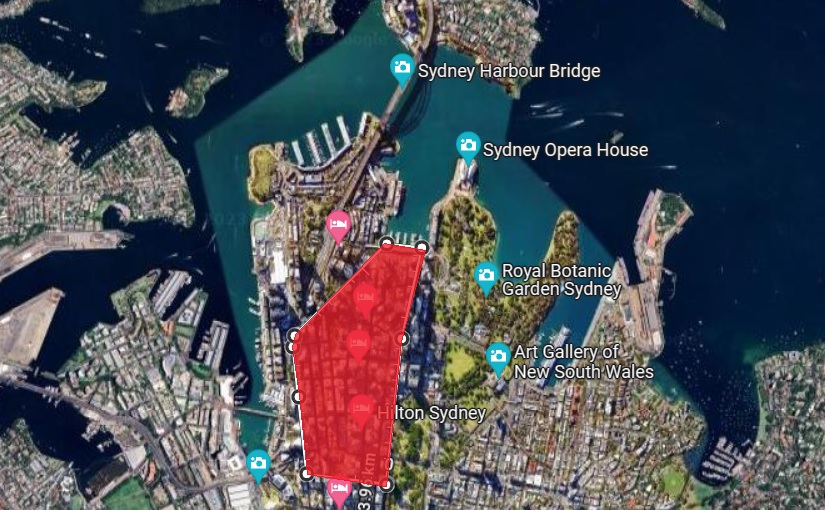
NSW Health is advising people who have been in the Sydney central business district (CBD) area (map above) on New Year’s Eve (NYE) to be on alert for symptoms of Legionnaires’ Disease after 7 people who have developed the disease spent time in the area in the last 3 weeks. This advice applies to anyone else who has been in the CBD since & including Christmas Eve (24 December).
Symptoms of Legionnaires’ disease can develop up to 10 days from the time of exposure to contaminated water particles in the air & include fever, chills, a cough and shortness of breath and may lead to severe chest infections such as pneumonia.
Those most at risk are people with underlying lung or other serious health conditions & people who smoke. People who develop Legionnaires’ Disease are diagnosed by a urine or sputum test and chest X-ray & usually require antibiotic treatment in hospital.
The southern boundary of the area pictured above is roughly in line with Sydney Town Hall/southern Hyde Park while the northern boundary is Sydney Harbour.
The only vantage point in the area of concern is the Cahill Expressway. However, most people would have been affected on the way to & from any vantage point if their path of travel took them through the CBD such as via the Sydney Harbour Bridge, Eastern Suburbs or ferries to/from Circular Quay. People who attended Sydney NYE vantage points such as Darling Harbour, Barangaroo Reserve, Observatory Hill Park, Dawes Point (Tar-ra Park), Hickson Road Reserve, Campbells Cove, The Rocks, West Circular Quay, East Circular Quay, the Sydney Opera House, The Domain: Tarpeian Lawn & the Royal Botanic Gardens: Bennelong Lawn, who are very likely to have traversed throughout the CBD from/to the event should also be especially cautious.
The 7 people who have already developed the disease, 3 women & 4 men, ranging in age from their 20’s to 70’s, independently visited locations in the CBD between Bathurst Street, Sussex Street, Elizabeth Street & Circular Quay in the 10 days prior to their symptoms. All have been admitted to hospital for treatment of pneumonia & have been identified with the Legionella bacteria that causes Legionnaires disease, which is often associated with contaminated cooling towers of large buildings.
NSW Health environmental health officers are working closely with the City of Sydney to inspect cooling towers & review the CBD cooling towers’ maintenance records, which will help determine further towers to be inspected & sampled.
Building managers with cooling towers are being contacted & informed of the cluster. Building owners should ensure that their cooling towers are operated & maintained in compliance with the NSW Public Health Regulation 2022.
People can be exposed to the Legionella bacteria if contaminated water particles from a cooling system are emitted into the air & breathed in. Legionnaires’ disease cannot be spread from person to person.
1 million people are expected to have attended Sydney New Year’s Eve 2023.
For more information about water cooling systems management contact your local public health unit on 1300 066 055 or https://www.health.nsw.gov.au/environment/legionellacontrol/Pages/default.aspx
For more information on Legionnaires’ disease visit: https://www.health.nsw.gov.au/Infectious/factsheets/Pages/legionnaires_disease.aspx
 Sydney Spectaculars